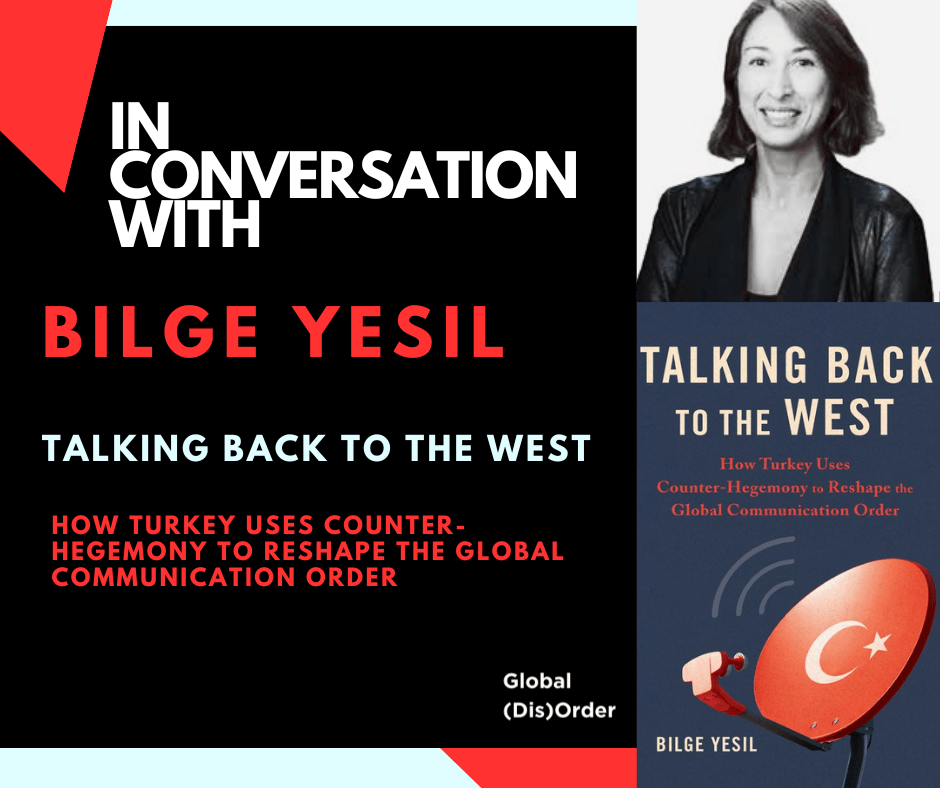
In this episode, Sasikumar Sundaram and Begum Zorlu speak with Bilge Yeşil, Professor of Media Culture at the College of Staten Island and affiliated faculty in Middle Eastern Studies at the CUNY Graduate Center, about her award-winning book Talking Back to the West: How Turkey Uses Counter-Hegemony to Reshape the Global Communication Order, published by University of Illinois Press.
Yeşil traces the origins of her research to a period of intense convergence between Turkey’s domestic and foreign policy crises in the 2010s. The Gezi Park protests of 2013, the corruption scandal that same year, the Syrian refugee crisis, and growing Western criticism of the AKP’s increasingly authoritarian trajectory all generated what she describes as a “communication crisis” for the Erdoğan regime. The government’s response was the construction of a sophisticated global media apparatus, most visibly through the launch of TRT World in 2015, Turkey’s first English-language 24/7 news channel, alongside expanded digital, social media, and news agency operations designed to legitimise its domestic and foreign policy choices to international audiences.
Yeşil identifies Muslim victimhood as one of the organising threads running through Turkey’s international communication strategy, a narrative with deep roots in Islamist intellectual traditions and Ottoman political culture. By casting the West as an inherently and essentially Islamophobic actor, the Erdoğan regime mobilises a binary of oppressor and oppressed that simultaneously appeals to Muslim-majority audiences across the Global South and positions Turkey as the benevolent guardian and self-appointed leader of the world’s Muslims. Yeşil is careful to note the hierarchical assumptions embedded in this posture.
The conversation turns to TRT World’s audience strategy and its selective deployment of progressive politics. The channel has increasingly covered issues such as Islamophobia, colonialism in Africa, police brutality, and far-right extremism in Europe, issues that resonate with progressive audiences in the West, whilst simultaneously broadcasting content antithetical to those same values. Yeşil argues this reflects a strategy she terms “strategic obfuscation”: the highlighting of undeniable truths and real injustices in ways that are deliberately partial, stripping away structural complexity and reducing it to a civilisational binary that serves the regime’s political interests.
The conversation situates this within a broader comparative frame, drawing parallels with Russia’s RT, China’s CGTN, and the communicative strategies of other rising powers including India and Brazil. Each, in different ways, instrumentalises Western hypocrisy and historical grievance, whether colonial humiliation, imperial decline, or moral injury, to contest Western hegemony and stake a claim to leadership in an emerging multipolar order.
The episode closes with Yeşil’s advice to early-career researchers: to resist the pull of presentism and dominant paradigms, and to invest in history and culture as indispensable lenses for understanding contemporary foreign policy and international communication, not as background, but as constitutive of the deeper currents that shape them.
You can listen to the episode on YouTube.


Leave a comment