
We are pleased to announce the Open Competition Call for Papers for the Spring 2026 Special Issue of the Brazilian Journal of International Politics (Revista Brasileira de Política Internacional), co-edited by Sasikumar Sundaram, Leonardo Ramos, and Begum Zorlu.
In recent years, it has become increasingly common in media, pundit, and academic circles to describe international politics as in a state of disorder. Our media commentators frequently categorize our age as “The Age of Disorder,” not the least due to unending wars, a global pandemic, disruptive social media technologies, growing support for fascism and xenophobic public policies, rise in violent crimes, income inequalities and economic downturns among others.
Practitioners are quick to point out to enemies for the problems of disorder. US Secretary of Defense Lloyd Austin, for instance, has claimed that “Russia’s invasion [of Ukraine] shows us all the danger of disorder and the cost of chaos.” Chinese President Xi Jinping stood in Kremlin and said, “Right now, there are changes – the likes of which we haven’t seen for 100 years – and we are the one driving these together.”
Many scholars observe the epistemic use of the concept of disorder to diagnose the problems of liberal international ordering. Some observers have suggested that this new disorder reflects a crisis of liberal internationalism.[iv] Many believe that global disorder is a structural feature of racial, economic, and social inequalities of world politics. Nevertheless, there are several theoretical, methodological, geographical, and topic gaps in the research on global order.
This special issue aims to make sense of global disorder in critical ways that puts Asia, Africa, and Latin America at the forefront of the debate on disorder. It asks: How to make sense of global disorder from the global south? We prioritize three interventions into the debates on global disorder at the theoretical, methodological, and topical issue areas. First, any conceptual discussion of global disorder requires a critical analysis that foregrounds the problems of global capitalism, the interconnected and transnational connection between elites, the challenges to technocrats and intelligent experts, and the weaponized interdependence of our economic system. Research on global disorder that takes entanglements, interconnections, and interdependence seriously requires novel structural theorization of its causes and consequences in the hierarchical international system.
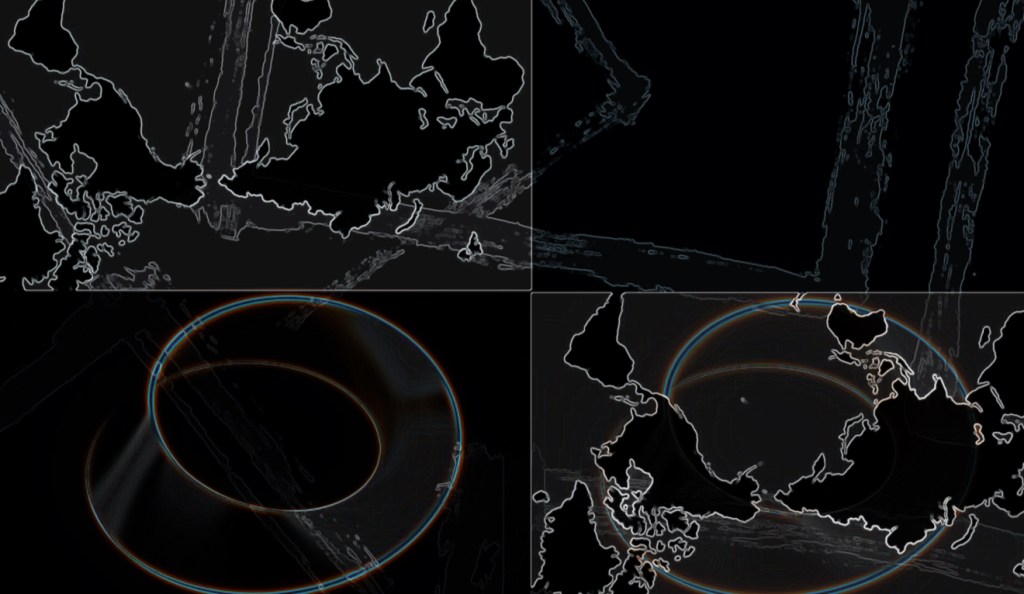
Second, we prioritize a methodological study of global disorder that examines the dynamic aspect of the world in flux. In an interconnected world, a clear study of global disorder requires analysis of relations, ties, intermediaries, chains, and connections among elites, and an analysis of flows and counterclaims. The ongoing dynamics in the world, like the Mobius strip pictured above, is about infinity, non-orientability, and the blending of opposites. Finally, prioritize a critical study of global disorder that should put Asia, Africa, and Latin America at the centre of investigation. Many state, non-state actors, and institutions in these regions are at the receiving end of the problems of disorder. Many global ordering issues creates tensions and contradictions in the periphery that then reverberates to the core in novel shapes and forms. Putting Asia, Africa, and Latin America at the heart of the analysis of disorder can generate original theoretical insights that might be useful for diagnosing the many political problems in the United States and Europe.
This call for contribution seeks papers that will interrogate these three themes and contribute to debate on making sense of global disorder from the global south. Papers can examine (1) theoretical issues about the problems of global disorder; (2) methodological investigations about the debates on studying the political and sociological dynamics of world politics; and (3) topical examinations of global disorder from different thematic areas, such as critical minerals and resource exploitation, cyber security and artificial intelligence, and the future of BRICS+.
Notes for contributors on workshops
We are accepting submissions via globaldisorderresearch@gmail.com until 30 October 2025. All submissions will be workshopped and discussed with peer reviewers. Please submit an abstract of 1000 words (excluding footnotes and references). All shortlisted papers will be discussed in an online workshop in November 2025. The next workshops and the development of the paper will be communicated subsequently. Abstracts should have the following information:
- Title
- Full name
- Position and institutional affiliation (unless you are an independent scholar)
- Email address
- Key words (up to five)
- Section where you think your contribution may fit best (e.g., theory, method, topical issues)
- Main text
About the journal
The Revista Brasileira de Política Internacional (RBPI) is a biannual publication established in 1958 by the Brazilian Institute of International Relations (IBRI). From 2020 the Journal has been published by the Center for Global Studies of the University of Brasília. RBPI is one of the top and most traditional journals on International Relations published in Latin America and one of the most influential in the field in the Global South. The article must be written exclusively in English and must have between 7,000 and 8,000 words, never exceeding 8,000 words (including title, abstract, bibliographic references, and keywords)
 Global (Dis)order
Leave a comment